 4.8 out of 5 stars! See what our customers are saying on
  Trustpilot

















Introduction
While the availability and quality of privacy-focused Android custom ROMs and compatible phone hardware have improved in the last few years, there appeared to be a lack of wireless mobile carriers with similar goals. One can argue that the privacy and security of your mobile phone is only as good as the wireless service. Until recently we were left to assume mobile providers were eager to profit from our personal data just like every other Big Tech corporation. Thankfully, today we have options. In this article we compare providers that claim enhanced privacy and security features.
Privacy & Security Features to Consider
At a minimum, the company's privacy policy should actually protect the customers' data, not profit from it. Other features we want to see include:
- Anonymous sign up option / no-KYC requirement
- Call, voicemail, and internet data encryption
- Minimized data collection
- SIM swap and fraud protection
- Insurance guarantee in case of loss
- Secure global roaming
- Network identifier shielding
Wireless mobile carrier services reviewed:
1. BraxSIM Unlisted
Overview
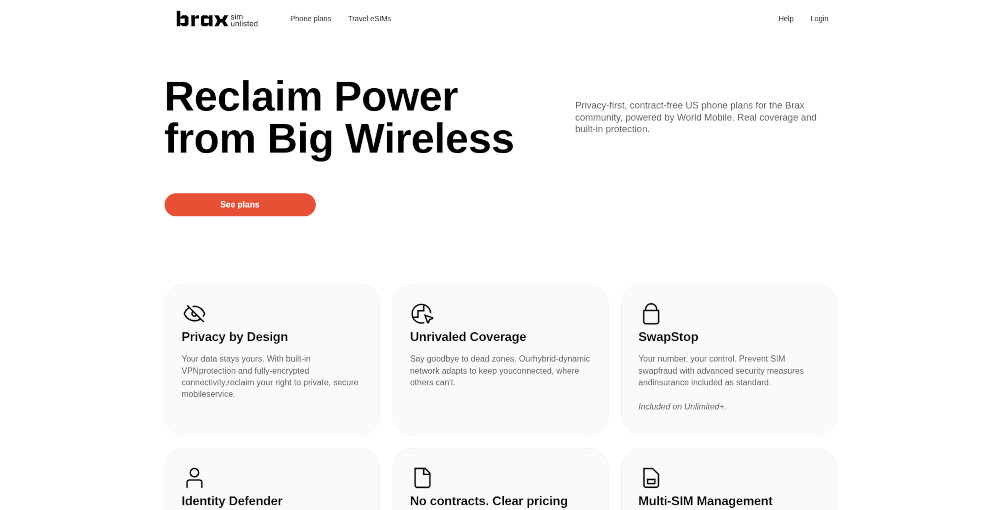
Rob Braxman, the "Internet Privacy Guy", introduced BraxSIM Unlisted in July 2026 as a privacy-first contract-free mobile wireless provider serving the United States and Canada. Primarily for the Brax.me community and powered by World Mobile's decentralized infrastructure, it is positioned as a Decentralized Mobile Virtual Network Operator (DMVNO). The service emphasizes user sovereignty and eliminating traditional carrier requirements for extensive personal identification.
Core Privacy Features
No ID requirement (no KYC) - Unlike standard mobile carriers that mandate identity verification, this service allows users to activate plans without submitting personal documentation. This makes it particularly suitable for individuals seeking a second line for two-factor authentication (2FA) or those wishing to keep their primary identity separate from their mobile usage.
Built-in VPN - All data traffic on the network is routed through a built-in VPN. This ensures that user data is encrypted at the source and randomly routed through over 1,000 servers before exiting the network. While the physical connection may utilize partner infrastructure like T-Mobile, the encryption and routing mask the user's activity, making the traffic appear normal at the exit point while remaining unreadable to intermediaries.
Security Protections
Beyond data encryption, higher tier Unlimited and Unlimited+ service includes measures to prevent account takeover and identity theft.
- SIM swap fraud protection - Designed to prevent malicious actors from transferring a user's phone number to a different device to intercept calls or texts.
- $1M Insurance policy - Unlimited+ tier provides enhanced identity protection accompanied by $1 million in insurance. This coverage helps safeguard personal information against modern mobile threats, offering financial recourse and monitoring services should a breach occur.
Network Architecture
The privacy model is underpinned by a decentralized network architecture provided by World Mobile. This infrastructure is designed to prevent data exploitation by removing centralized points of control where user data is typically harvested. The system functions as a DMVNO, where Brax manages the community and World Mobile handles the technical telecom foundation, including eSIM provisioning and compliance.
Plan-Specific Privacy Benefits
Privacy features are distributed across various monthly plans, ranging from $15 to $70. The entry-level Starter plan ($15/month) includes the core privacy benefits of no contracts, built-in VPN protection, and no ID requirements, making it an accessible option for privacy-focused secondary lines.
Higher-tier plans expand on these protections. The Unlimited+ plan ($55/month) bundles SIM swap protection and enhanced identity monitoring with $1 million insurance. For international users or travelers, the Global Access data-only plan offers privacy-centric connectivity in over 60 countries without exposing the user to the Public Switched Telephone Network (PSTN) when paired with Brax Virtual Phone services.
BraxSIM Unlisted - Summary
Nationwide U.S. + Canada 4G/5G coverage; secure roaming in 60+ countries
Plans start at $15/month and include no ID required, no contracts, built-in VPN
Unlimited+ plan provides SIM-swap protection + $1 million insurance policy
20GB high-speed data-only plans with coverage in 60+ countries
Accepts credit/debit cards; no mention of cryptocurrency payment
2. Cape
Overview
Cape is a privacy-first Mobile Virtual Network Operator (MVNO) that distinguishes itself by operating its own cloud-native mobile core, allowing it to control data flow and minimize information exposure compared to traditional carriers. Its primary value proposition is collecting the minimum amount of data necessary to provide service and never selling user data.
Cape’s architecture is designed around the principle that data which is not collected cannot be leaked or sold. Unlike standard carriers that retain user history for years, Cape deletes most metadata within 24 to 60 days. The service requires no names, Social Security Numbers, or street addresses for sign-up, identifying accounts primarily by phone number.
Key Security Features
Cape implements several proprietary technologies to protect users from network-level attacks and tracking.
- Identifier Rotation - To prevent persistent tracking by advertisers and data brokers, Cape automatically rotates the user’s International Mobile Subscriber ID (IMSI) every 24 hours. This makes the device appear as a different subscriber daily, disrupting location profiling and ad targeting.
- SIM Swap Protection - Addressing a common vector for identity theft, Cape secures phone numbers with a 24-word recovery phrase generated locally on the user's device. This private key ensures that only the user can authorize number transfers, preventing attackers from bribing or tricking carrier representatives into porting numbers.
- Encrypted Voicemail - Voicemails are encrypted upon arrival using a key stored only on the user's device. This end-to-end encryption ensures that even Cape employees or system administrators cannot access or listen to voicemail contents.
- Network Lock & Signaling Protection - The service includes a proprietary signaling proxy that monitors network requests to block SS7 attacks. These attacks often exploit legacy telecom infrastructure to intercept calls, texts, or track location. Cape verifies that a device’s network attachment matches its physical location to automatically block mismatches.
- Disappearing Call Logs - While traditional carriers monetize call detail records (CDRs) for years, Cape deletes call and text logs after just 24 hours and SIP messages 14 days. This limits the exposure of metadata that could reveal a user's relationships, habits, or location history in the event of a breach.
Core Privacy Features
- Minimal data collection: Cape says it collects only the minimum needed to provide service. It also claims it doesn’t collect email or location data.
- Data retention + no selling: Cape says collected data is deleted as soon as possible and is never sold.
- Secondary Numbers: Cape provides two additional real phone numbers in the plan (positioned to reduce exposure of your main number)
- Secure Global Roaming: Cape says international roaming routes traffic through its US-based core to avoid exposing identity/communications.
Data Collection & Retention
Cape’s privacy policy outlines a strict limitation on data types and retention periods.
- Payment Data: Credit card numbers are tokenized by Stripe; Cape never stores full card details or associates tokens with specific subscribers.
- Location Data: Cape does not collect GPS coordinates unless e911 services are used. Cell ID data is retained for only 60 days for billing reconciliation.
- Personal Identifiers: Names and addresses are not collected. Zip codes are collected solely for tax purposes and retained for 3 years.
- Browser History: The carrier does not inspect egress data or DNS queries via deep packet inspection.
Critical Considerations
While Cape offers robust privacy features, independent analysis highlights specific trade-offs.
- Mandatory App Usage: Subscribers must use the Cape app, which some critics argue introduces a potential attack surface via the device's baseband processor and closed-source firmware.
- Data Requirements for Features: Security expert Paul Walsh has noted that features like IMSI rotation and Network Lock technically require Cape to maintain real-time mapping tables and continuous GPS access, meaning the carrier processes significant data to enable privacy, even if it is not stored long-term.
- SMS Scanning: The privacy policy indicates a capability for Cape or its partners to scan SMS content if spam or scam campaigns are suspected, with no explicit opt-out mechanism mentioned.
Cape - Summary
Nationwide U.S. 4G/5G coverage; secure roaming in 50+ countries
Minimal data collection; no name, SSN, or address requested during onboarding
Daily IMSI/identifier rotation on supported devices
SIM-swap protection through locally generated 24-word recovery phrase
Traffic routed through Cape’s mobile core
Network lock; encrypted voicemail; secondary numbers; signaling-attack protection
Accepts credit/debit cards; no mention of cryptocurrency payment
$99/month standard; $70/month for life for eligible early adopters
Subscribers must use Cape's closed-source app
3. Efani
Overview
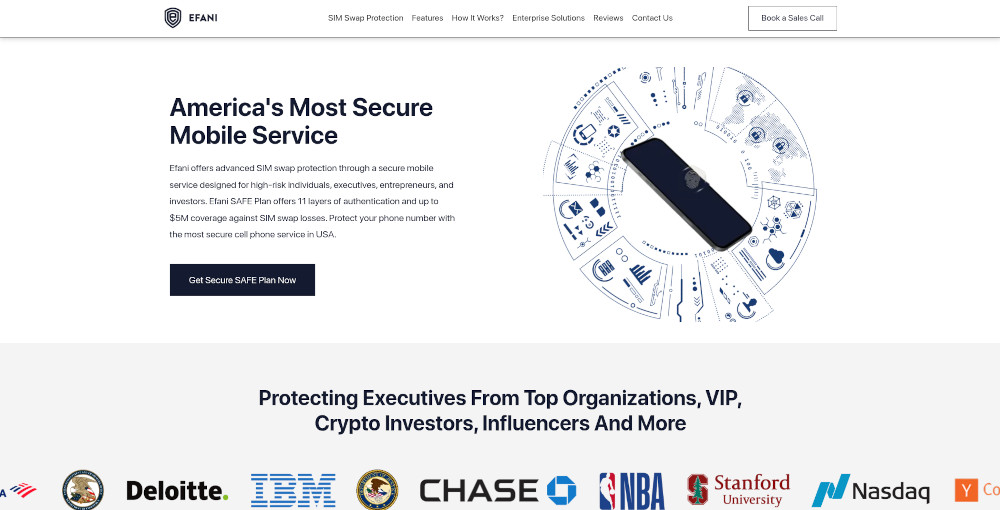
Efani is a security-focused Mobile Virtual Network Operator (MVNO) designed specifically for high-risk individuals, such as executives and cryptocurrency investors, with a primary focus on preventing SIM swapping and ensuring user anonymity.
While it uses AT&T and Verizon infrastructure for coverage, Efani ensures that your personal information (name, address, payment details) is not stored in or accessible by the underlying carrier databases. This prevents carriers from collecting usage data, selling information to third parties, or exposing customer details to store employees and potential hackers.
Core Privacy Philosophy
Efani operates on the principle that mobile carriers should not possess or sell user data. By removing personal identifiers from the carrier database, Efani ensures that even if the underlying network infrastructure is compromised, the user's identity remains obscured.
While Efani offers superior privacy compared to traditional carriers, users paying with credit card must still provide some personal information (name, address) during signup for identity verification. Upon request, Efani will accept payment in Bitcoin, eliminating the need for strict KYC.
Privacy and Security Features
- 11-Layer Authentication Protocol: A verification system requiring multiple automated and manual human reviews for any account changes, such as SIM swaps or number porting.
- 14-Day Cooling-Off Period: Any requested account change is held for 14 days after approval, allowing users time to detect and report suspicious activity before the change takes effect.
- Zero Data Sharing with Carriers: Efani explicitly does not share subscriber identity with AT&T or Verizon, shielding users from carrier-side data breaches and surveillance.
- $5 Million Insurance Policy: The service backs its security with a comprehensive insurance policy that covers up to $5 million in financial losses resulting from successful SIM swap attacks.
- Encrypted Communications: Efani employs end-to-end encryption for communications and uses AES-256 encryption for data at rest, ensuring that stored information remains secure and unreadable without proper keys.
- Privacy-Focused Support: Accounts are managed with white-glove support, and for higher-risk clients, Efani offers Black Seal Protection (invite-only) which guards against advanced threats like DDoS, SS7 location tracking, and fake tower attacks.
Encryption Standards
Efani employs rigorous encryption protocols to protect data both in transit and at rest. The service utilizes AES-256 encryption for all stored data and HTTPS/TLS encryption for data transmission.
For specific high-security applications, such as the Black Seal Protection service (available by invitation), Efani implements additional measures:
- End-to-end encryption for communications
- Secure credential storage in iOS Keychain
- Real-time processing of phone scan data without storage
- Protection against SS7 attacks, eavesdropping, and location tracking
Efani - Summary
Serving North America, AT&T & Verizon networks; international data and calling included
Eleven-layer account authentication and mandatory cooling-off period for port-outs
Up to $5 million in SIM-swap-loss coverage backed by Lloyd’s of London
Employs rigorous encryption protocols to protect data both in transit and at rest
Optional dual eSIM and manual network selection
Personalized security support, with privacy and anonymity options
Traditional payment methods accepted; will accept Bitcoin upon request
$99/month or $999/year
Number transfers can involve a 15-day security window
4. Phreeli
Overview
Phreeli is a privacy-focused U.S. Mobile Virtual Network Operator (MVNO) founded by Nicholas Merrill, privacy advocate and founder of the Calyx Institute. Its objective is to minimize the information associated with a wireless account and to keep account, payment, and telecommunications activity separated. The strongest evidence for its privacy practices is Phreeli’s published privacy policy and terms of service.
Key Security Features
Double-Blind Armadillo architecture. Phreeli says its architecture separates account information, payment information, and telecommunications activity. Its policy states that a customer’s username, ZIP code, and payment information are not associated with the customer’s phone number, calls, texts, or data usage.
Encryption and data filtering. Phreeli states that stored personal information is encrypted both in transit and at rest.
Reduced account-verification requirements. For eSIM products, no name or physical address is required to sign up (depending on payment type).
Core Privacy Features
Phreeli’s privacy design reduces the amount of information that can be connected in one place.
| Area | Phreeli's Approach | Consideration |
| Signup Information | Minimized; no credit check; eSIM signup can avoid providing a name or physical address | Stronger than conventional carriers, but not information-free |
| Account/activity separation | Claims to separate username, ZIP code, payment information, phone number, and usage activity | One of Phreeli’s most distinctive privacy features |
| Payment privacy | Accepts most debit and credit cards and offers payments in Bitcoin, ZCash, Monero, and other cryptocurrency | Cryptocurrency can reduce ordinary billing linkage, but card payments remain linkable to the payment provider |
| Data monetization | Says it does not sell customer data | Positive, but customers should distinguish “not sold” from “not collected” |
| User controls | Customers may request deletion, correction, and information about categories of data collected and disclosed | Meaningful rights, subject to legal and operational exceptions |
Data Collection and Retention
Phreeli’s policy uses a data-minimization model: the information collected depends on the service used, how it is purchased, and how it is delivered. The retention policy states it generally deletes personal-information records immediately after their essential purpose has been fulfilled.
Phreeli - Summary
U.S. nationwide service; domestic roaming may be available
International calling reaches 100+ destinations
Minimized data collection and advanced privacy controls; open-source encryption where possible
“Double-Blind Armadillo” separation of account/payment data from telecommunications activity
eSIM option that does not require a name or physical address
$25/month Flex plan, plus $20 per additional 5 GB after the included 2 GB
Accepts credit/debit cards, Bitcoin, Zcash, Monero and other cryptocurrencies
No mention of protection from SIM swap attacks or insurance coverage options
5. Silent.link
Overview
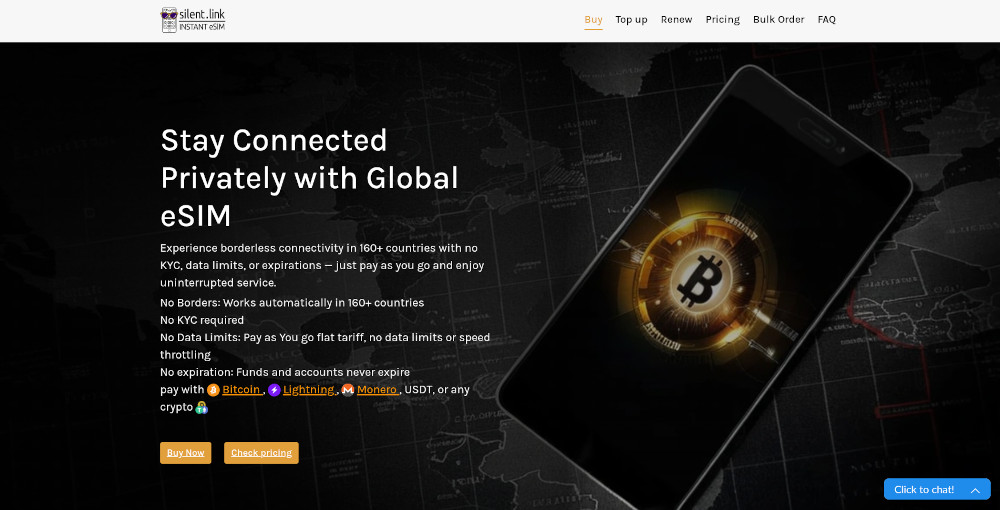
Silent.link is a no-KYC (Know Your Customer) global roaming eSIM provider operating in 160+ countries. It is designed to eliminate the link between mobile connectivity and personal identity. The service functions without user accounts, email addresses, or phone number verification during the purchase process. Instead of traditional login credentials, access is managed via a unique Order URL generated immediately after payment, which acts as the sole key to manage the eSIM profile.
The platform explicitly states it gathers no user data. Because no personal information is collected, there is no database of user identities that can be compromised, subpoenaed, or sold to third parties. This "accountless" model ensures that even the local data carriers providing the underlying network infrastructure do not know the end-user's phone number or identity.
Payment & Identity Anonymity
Silent.link enforces anonymity through its strict payment infrastructure. The service accepts cryptocurrencies including Monero (XMR), Bitcoin (BTC), and Lightning Network payments via a self-hosted BTCPay Server.
Users can purchase data plans and virtual phone numbers (US +1 or UK +44) without providing an email address. The eSIM profile is delivered instantly via the Order URL or optionally through Telegram, bypassing traditional email verification steps. This allows for the creation of "burner" identities suitable for activists, journalists, or privacy-conscious travelers who need to avoid surveillance or SIM-swap attacks.
Technical Privacy Specifications
The service routes all internet traffic through gateways located in Poland. While this places data within the EU (benefiting from GDPR protections), it also means traffic passes through a NATO member state with intelligence-sharing agreements. The service supports Tor and does not block onion routing or alternative networks, nor does it impose CAPTCHAs that could compromise anonymity.
Silent.link offers IDENTITY plans that provide non-VoIP phone numbers capable of receiving SMS for two-factor authentication (2FA) and messenger registration. These numbers allow users to authenticate services without revealing their primary carrier identity. The eSIMs support global roaming in roughly 160 countries, automatically connecting to local networks without requiring new identity verification at borders.
Limitations & Trade-offs
Despite its strong privacy stance, Silent.link has notable operational constraints. The service is data-only by default; it does not support legacy GSM voice calls or outgoing SMS, though incoming calls and SMS are permitted for activation and verification purposes. Users must rely on VoIP services, and applications like Signal or WhatsApp for voice communication.
Customer support is limited, expecting users to be technically proficient. Reinstalling eSIMs on new devices can be restrictive; while data plans can sometimes be transferred via support tickets using Order URLs, single-use IDENTITY numbers generally cannot be moved once deactivated.
Silent.link - Summary
Global roaming 4G/5G data-only eSIM operating in 160+ countries
No KYC; No email address required; no account expiration; no balance expiration
Pay-as-you-go: U.S. data rates from $1.60/GB; Europe from $0.83/GB
Bitcoin, Lightning, Monero, USDT, and other cryptocurrencies/altcoins accepted
Requires an eSIM-compatible device
Inbound SMS only, outbound SMS is not allowed
Legacy voice calling is not provided
6. Tello
Overview
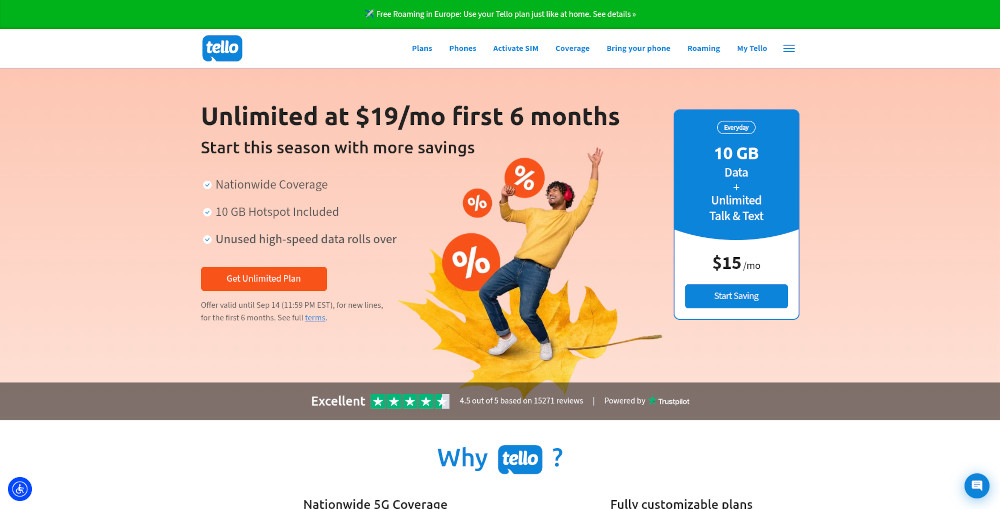
Tello Mobile is a low-cost mobile virtual network operator (MVNO) that provides prepaid cell phone services using the T-Mobile network. It offers plans with options for unlimited talk, text, and mobile data. While its products and services are not focused on enhanced privacy and security, it is a solid choice for users that want straight-forward and affordable service with minimal carrier involvement.
Security Features
Tello employs several mechanisms to protect account integrity and prevent unauthorized access, though some rely on user configuration.
Security PIN and Passwords: The primary account protection feature is the Security PIN, which is required for sensitive actions such as changing account details or porting out a phone number. Tello supports very long and random account passwords, which serve as the first line of defense for the Security PIN.
Two-Factor Authentication (2FA): Tello has implemented 2FA for its website, adding an extra layer of security beyond just a password. While Tello states that sensitive changes still require the current PIN and password, the reliance on SMS for app access has been a point of discussion regarding potential vulnerabilities if a phone is lost.
Fraud Protection: The company collects data specifically to authenticate user identity during support interactions or app usage. Operationally necessary cookies and technologies are always active to identify irregular site behavior, prevent fraudulent activity, and ensure network security; these cannot be switched off by the user.
Personal Data Collection
Tello collects specific categories of personal information to operate its mobile services, distinguishing between data volunteered by users and data collected automatically.
- Account and Contact Information: Tello collects personally identifiable information such as names, postal addresses, phone numbers, email addresses, and credit card numbers when voluntarily submitted. This data is used primarily to fulfill requests, process orders, or manage user accounts. Users can modify or delete optional profile information via the "My Profile" feature.
- Communication Data: A key privacy feature is Tello's handling of message content. The company does not retain user messages in the ordinary course of business; messages are stored on the user's device and deleted from Tello's servers once delivered. However, Tello does collect Call Detail Records (CPNI), which include information about the type, location, destination, and volume of calls and texts, but not the content of the conversations.
- Device and Usage Data: Automatic collection includes hardware models, operating system details, IP addresses, mobile network information, and unique device identifiers. Tello also gathers diagnostic data, crash reports, and usage patterns (timing, frequency, and duration of activities) to maintain service performance. Notably, while the app uses the microphone to transmit audio during calls, it does not have an audio recording function.
Third-Party Sharing
Tello's privacy policy outlines specific scenarios where data may be shared, primarily to facilitate service delivery. Service data is shared with trusted partners to monitor service usage, process payments, and handle communications.
Tello may also disclose data if required by law or to protect the rights and safety of the company and its users. Affiliates and Partners data may be shared with affiliates (parent companies or subsidiaries) and business partners to offer specific products or promotions.
Tello - Summary
U.S. service, including Puerto Rico and the U.S. Virgin Islands
International roaming is available in 200+ countries using Pay-As-You-Go credit
Conventional account security PIN
Ability to opt out of certain data sharing, “Do Not Sell or Share” controls
Plans starting at $8/month for unlimited talk and text
Accepts credit/debit cards, PayPal, Venmo, Apple/Google Pay; No cryptocurrency option
No enhanced carrier-level privacy architecture or dedicated SIM-swap insurance
Account/billing, device, and service data collected and may be shared with service providers
Conclusion
Anyone who needs a balanced focus on security and privacy, especially high-risk individuals seeking protection from SIM-swap attacks will be wise to contact Efani.
Cape, Phreeli, and BraxSIM collect minimal customer data, add privacy features, and deter SIM swap exploits in certain cases. Customers that require absolute anonymity while utilizing mobile data on a wireless network should consider Silent.link. If cost and ease of use are the priority over specialized security features, then Tello's traditional carrier plans are a clear winner.
With that said, “Enhanced privacy” does not mean that the phone itself is anonymous. Device identifiers, radio-location data, app telemetry, operating-system services, and the content of ordinary SMS or cellular calls can still create privacy exposure. For the most sensitive communications, end-to-end encrypted messaging and a privacy-focused device configuration remain important.